

Your building is finally complete, the contractors have finished their work, and the project team has obtained the Certificate of Completion and Compliance (CCC). Everything seems ready for the next stage.
But does having a CCC mean you no longer need a Fire Certificate?
This question often creates confusion among building owners, developers and facility managers. Although both documents relate to building safety and compliance, they serve different purposes.
Understanding the difference between a Fire Certificate and CCC in Malaysia can help you avoid unnecessary delays, missing documentation and compliance problems.
A CCC confirms that a building has reached the required completion and compliance stage under the applicable building framework. Meanwhile, a Fire Certificate addresses specific fire safety requirements for designated premises.
FESDES provides fire engineering consultancy in Malaysia to help building owners understand fire safety requirements, review technical concerns and prepare for relevant compliance matters.
This guide explains how the two certificates differ, who issues them and what owners should consider before building occupation or operation.
ㅤ
ㅤ
Fire Certificate vs CCC Malaysia: What Is the Main Difference?
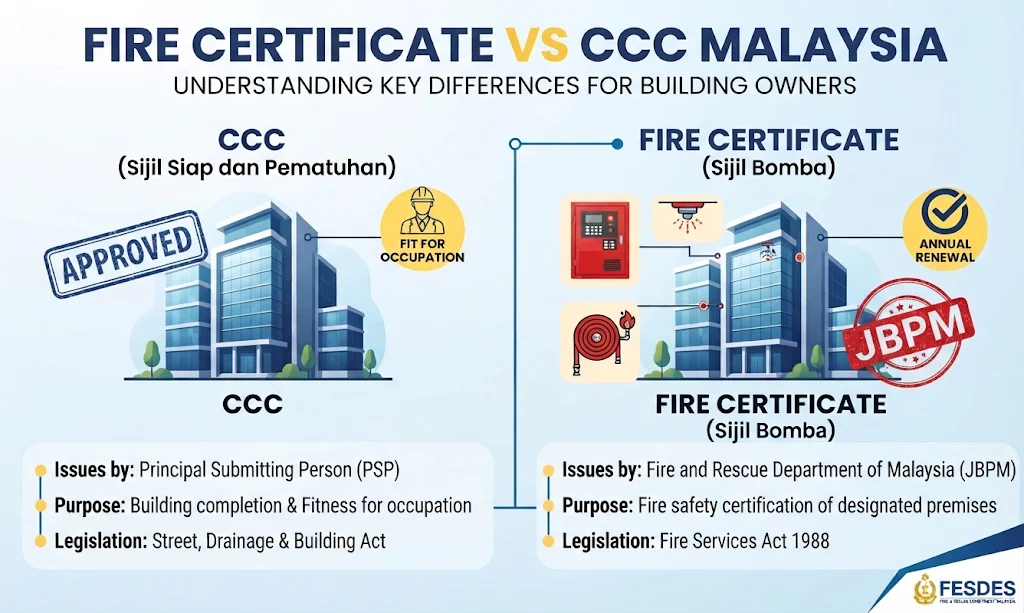
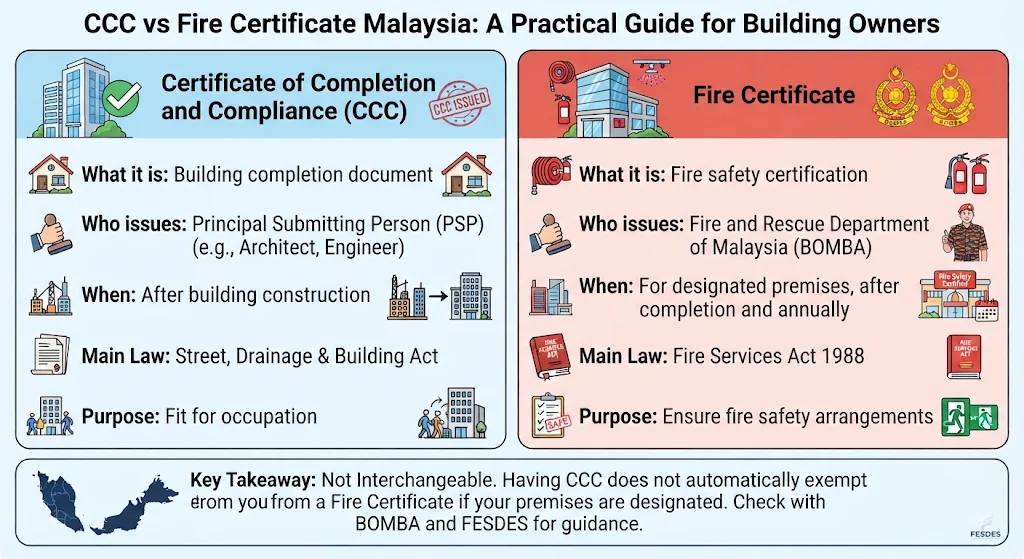
The main difference lies in what each document certifies and which party issues it.
A Certificate of Completion and Compliance confirms that a building has met the applicable completion requirements and is fit for occupation under the relevant building regulatory framework.
A Fire Certificate, on the other hand, relates specifically to fire safety requirements for premises designated under Malaysia’s Fire Services Act 1988.
Here is a practical comparison:
| Item | CCC | Fire Certificate |
| Full name | Certificate of Completion and Compliance | Fire Certificate |
| Main purpose | Building completion and fitness for occupation | Fire safety certification of designated premises |
| Issuing party | Principal Submitting Person (PSP) | Fire and Rescue Department of Malaysia (JBPM) under the statutory framework |
| Main legislation | Street, Drainage and Building Act and applicable building by-laws | Fire Services Act 1988 and relevant regulations |
| When relevant | Building completion stage | When premises fall within the designated-premises requirements |
| Annual renewal | No equivalent routine annual renewal | Yes, annual renewal required |
| Applies to | Building work subject to the relevant CCC framework | Designated premises under applicable law |
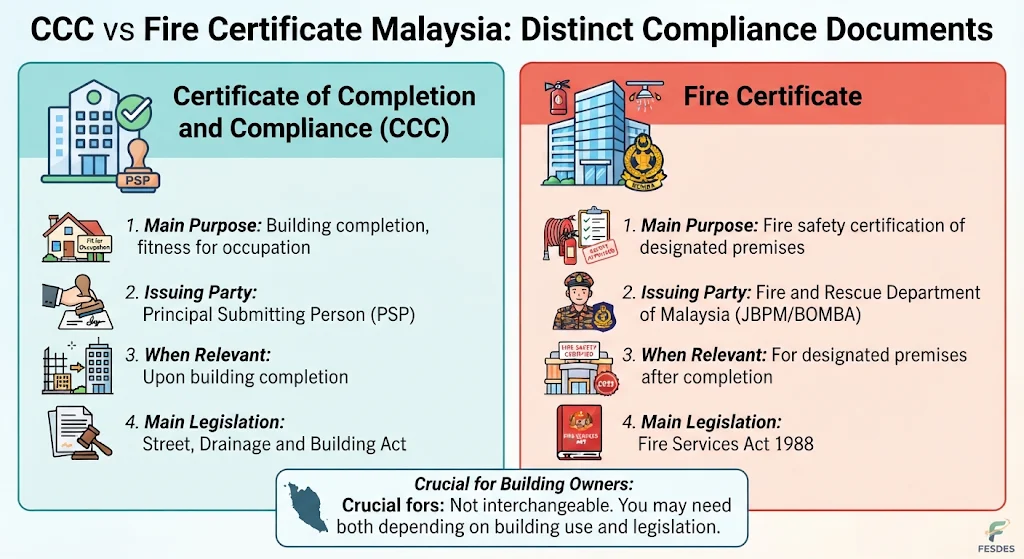
These documents are not interchangeable.
For example, an owner may have a valid CCC for a completed building but still need to apply for a Fire Certificate because the premises fall within a designated category.
The Department of Local Government’s official CCC guidance explains the CCC framework and the responsibility of the Principal Submitting Person.
Meanwhile, the Fire Services Act 1988 establishes the separate requirements concerning Fire Certificates.
ㅤ
ㅤ
What Is a Certificate of Completion and Compliance (CCC)?
A Certificate of Completion and Compliance, commonly known as CCC, forms part of Malaysia’s building completion framework.
It confirms that the relevant building work has reached the required completion stage and satisfies the applicable conditions for occupation.
Malaysia introduced the CCC system in 2007 to replace the earlier Certificate of Fitness for Occupation (CFO) system for projects covered by the new framework.
Unlike the former CFO process, a qualified Principal Submitting Person issues the CCC.
The PSP has important responsibilities throughout the project, including supervising the relevant building work and confirming compliance with approved plans and applicable technical requirements.
Who Can Issue a CCC in Malaysia?
The Principal Submitting Person must hold the appropriate professional qualifications and authority for the relevant project.
Depending on the development, the PSP may be a registered architect, professional engineer with the required practising credentials or another appropriately authorised professional within the applicable submission framework.
Importantly, the local authority does not simply issue the CCC on behalf of the project consultant.
Instead, the local authority retains oversight and enforcement powers within the statutory process.
Building owners can refer to the Board of Engineers Malaysia’s CCC resources for information about the relevant forms and professional submission requirements.
What Does the CCC Process Cover?
Building completion involves several technical disciplines.
These may include structural works, building services, essential utilities, relevant safety provisions and compliance with approved building plans.
Fire safety forms part of this wider process.
For instance, the project team may need to coordinate fire protection installations, relevant technical clearances and completion documentation before the PSP can issue the CCC.
FESDES explains the broader completion process in its article on what CCC means in construction.
ㅤ
ㅤ
What Is a Fire Certificate in Malaysia?
A Fire Certificate is a separate statutory certificate relating to fire safety in designated premises.
Malaysia’s Fire Services Act 1988 establishes the framework for identifying designated premises and requiring appropriate fire safety certification.
Under Section 28, designated premises require a Fire Certificate, subject to the exceptions and other provisions of the Act.
The certificate relates to whether the premises have adequate fire safety arrangements and facilities for their intended use.
For example, the relevant assessment may consider fire prevention, fire protection, fire-fighting facilities and life safety provisions.
However, the actual requirements depend on the building’s characteristics and the applicable regulatory provisions.
Who Issues a Fire Certificate?
The Fire and Rescue Department of Malaysia, commonly known as BOMBA or JBPM, administers Fire Certificate matters under the applicable legislation.
Section 29 of the Fire Services Act provides for the application and inspection process.
The authority may require relevant plans, supporting particulars and an assessment of the premises before issuing the certificate.
Building owners should therefore distinguish between technical preparation carried out by consultants and contractors and the authority’s statutory certification responsibilities.
FESDES offers Fire Certificate application and renewal advisory for owners who need assistance with relevant fire safety matters.
Does a Fire Certificate Need Annual Renewal?
Yes. Section 28 of the Fire Services Act requires annual renewal of Fire Certificates for designated premises.
A building owner should therefore maintain the relevant fire safety arrangements and organise the information needed for the applicable renewal procedure.
Unlike the CCC, a Fire Certificate involves an ongoing renewal obligation.
ㅤ
ㅤ
Do You Need a Fire Certificate After Obtaining CCC?
This depends on whether your building falls within the designated-premises requirements.
Obtaining CCC does not automatically remove the need for a Fire Certificate.
For new designated premises, the Fire Certificate application process may follow completion and the issuance of the relevant CCC or other applicable completion document.
FESDES’s existing Fire Certificate application guide also explains the relationship between building completion documents and Fire Certificate applications.
However, the precise sequence and documentation requirements should be confirmed with the responsible authority for the premises.
Consider a newly completed commercial development.
The project team may obtain CCC after fulfilling the relevant building completion requirements. Nevertheless, the owner must separately establish whether the premises fall under the Fire Certificate framework.
If the building qualifies as designated premises, the owner needs to follow the applicable Fire Certificate application procedure.
Therefore, obtaining one document should not lead to assumptions about the other.
 ㅤ
ㅤ
Does Every Building in Malaysia Need Both Certificates?
No. The requirements depend on the applicable legislation, building category and project circumstances.
CCC applies to relevant building work under the applicable building completion framework.
Fire Certificate requirements are more specific.
Only premises that fall within the designated-premises framework must obtain the relevant Fire Certificate, subject to the statutory provisions.
For example, certain industrial, commercial or public-use buildings may fall within designated categories because of their prescribed characteristics.
However, owners should not assume that every office, warehouse, shop or residential building automatically requires a Fire Certificate.
The designation depends on the applicable legal criteria, not merely the general building description.
If you manage an existing facility, confirm its classification and requirements through the appropriate BOMBA office or qualified project professionals.
This is especially important when the building has undergone substantial changes.
ㅤ
ㅤ
How Does BOMBA Relate to CCC and Fire Certificate Processes?
BOMBA can have a role in both processes, but that does not make the certificates identical.
During building completion, the project team may need to coordinate relevant fire safety inspections, clearances and supporting documentation.
Under the applicable CCC framework, Forms G8 and G9 relate to fire safety stage certification matters involving JBPM.
The Principal Submitting Person remains responsible for issuing the CCC according to the relevant statutory requirements.
For Fire Certificate matters, BOMBA operates under the separate Fire Services Act framework.
The authority assesses the designated premises against the relevant fire safety requirements before determining whether to issue the certificate.
Why This Distinction Matters
Imagine a project manager telling the building owner:
“BOMBA has already reviewed the fire safety installation, so everything is settled.”
That statement may overlook an important distinction.
A fire safety clearance associated with building completion does not automatically establish that every separate Fire Certificate obligation has been fulfilled.
Likewise, a Fire Certificate does not replace the building completion certification process.
Owners should check the actual document, its purpose and the relevant legal obligation rather than relying on verbal confirmation.
ㅤ
ㅤ
Fire Engineering Considerations Before Building Completion
Fire safety becomes more difficult and expensive to correct when a project reaches its final stages.
For example, a completed building may still have unresolved concerns involving escape arrangements, fire system interfaces or technical documentation.
Contractors may have installed the specified equipment, but the wider system still requires appropriate coordination and verification.
Fire engineering assessment can help the responsible project professionals identify these issues earlier.
Depending on the building, important considerations may include:
- Means of escape and evacuation arrangements
- Fire detection and alarm requirements
- Sprinkler and water-based protection systems
- Fire compartmentation
- Smoke management provisions
- Emergency lighting and exit signage
- Fire safety system interfaces
- Technical drawings and relevant test records
Not every item applies equally to every development.
Nevertheless, early technical coordination helps reduce the risk of discovering important problems shortly before handover.
FESDES provides fire protection consultancy for building projects where owners and project teams need professional fire safety advice.
ㅤ
ㅤ
A Practical Example: New Factory Completion in Malaysia
Consider a hypothetical manufacturer completing a new production facility.
The project team has finished construction and installed the required building services. The Principal Submitting Person is reviewing the necessary completion documents before issuing the CCC.
Meanwhile, the factory owner is preparing to move production equipment into the premises.
At this point, the owner needs answers to several questions.
Does the facility qualify as designated premises under the Fire Services Act?
Will the proposed manufacturing activities change any fire risk assumptions considered during design?
Are the relevant fire protection systems consistent with the completed building and intended operation?
Which documents will the owner need for any separate Fire Certificate application?
The answer may involve the architect, relevant engineers, facility management team, specialist contractors and BOMBA.
A clear understanding of CCC and Fire Certificate responsibilities helps everyone coordinate the next steps.
This example illustrates an important principle: building completion and ongoing fire safety obligations are related, but they remain distinct responsibilities.
ㅤ
ㅤ
Documents Building Owners Should Organise
Poor documentation can make compliance preparation unnecessarily frustrating.
A building may have suitable fire protection systems, yet the management team may struggle to locate the latest drawings or identify which contractor carried out particular works.
Before the handover stage, owners should establish a reliable document record.
Depending on the premises and applicable process, useful documents may include:
- Approved building plans
- CCC and relevant supporting records
- Applicable Forms G and technical clearances
- Fire protection system drawings
- Testing and commissioning reports
- Equipment specifications
- As-built drawings
- Maintenance and inspection information
- Previous Fire Certificate records, where applicable
- Documents relating to significant building modifications
The applicable authority may require additional or different information.
Therefore, owners should confirm the exact submission requirements rather than assuming that a general checklist will cover every case.
Well-organised records also help facility teams manage future renovations and maintenance.
ㅤ
ㅤ
What Happens When a Building Changes After CCC?
A CCC reflects the relevant building completion and compliance process at the time of issuance.
However, buildings rarely remain unchanged forever.
An office may introduce additional meeting rooms. A warehouse could increase its storage height, while a factory might install new production machinery.
These modifications can affect fire protection systems, escape arrangements and other safety considerations.
A building owner should not assume that the original fire safety strategy remains suitable after significant changes.
Depending on the nature of the work, additional technical reviews, approvals or updated documentation may be necessary.
For designated premises, changes may also affect Fire Certificate-related obligations.
The safest approach is to involve the appropriate professionals before major modifications begin.
ㅤ
ㅤ
Common Mistakes Building Owners Should Avoid
Confusion about CCC and Fire Certificate requirements can create unnecessary administrative and technical problems.
One common mistake involves assuming that a CCC covers every future fire safety obligation.
Another occurs when the management team treats an existing Fire Certificate as proof that all subsequent building modifications are acceptable.
Owners should also avoid relying on outdated drawings or incomplete contractor documentation.
Before proceeding with occupation or major operational changes, check whether:
- The relevant completion documents are available
- The building requires a separate Fire Certificate
- Important fire safety modifications need further review
- Relevant technical records reflect the current premises
- Outstanding defects require corrective action
- The responsible professionals have clarified the next steps
This approach provides a more reliable foundation than waiting for an issue to appear during inspection.
ㅤ
ㅤ
How FESDES Supports CCC and Fire Certificate Preparation
FESDES provides fire engineering and technical consultancy for building projects across Malaysia.
Its service portfolio includes Certificate of Completion and Compliance advisory and Fire Certificate application and renewal support.
Depending on the agreed project scope, FESDES can help clients discuss relevant fire engineering requirements, identify technical concerns and coordinate fire safety preparation.
Examples of potential advisory activities include:
- Fire safety design review
- Fire engineering assessment
- Fire protection system advisory
- Relevant compliance gap assessment
- Coordination of technical requirements
- Fire safety documentation review
- Building modification considerations
- Fire Certificate preparation advisory
FESDES does not replace the Principal Submitting Person responsible for issuing CCC or the relevant authority responsible for Fire Certificates.
Instead, the consultancy can support the project team with specialist fire engineering input appropriate to the building.
ㅤ
ㅤ
Get Fire Certificate and CCC Advisory in Malaysia
If you are approaching building completion, planning occupation or reviewing Fire Certificate obligations, clear technical advice can help you understand what to prepare.
Start by confirming the status of your CCC, the building’s intended use and whether the premises fall within the designated-premises framework.
Then, identify any unresolved fire safety issues or significant building modifications.
FESDES can discuss your building’s fire engineering requirements and the technical considerations relevant to CCC and Fire Certificate preparation.
Whether your project involves a factory, commercial development, warehouse or existing facility, early coordination can help you avoid unnecessary uncertainty.
Contact FESDES to discuss your building’s fire engineering and compliance-related advisory needs.
ㅤ
ㅤ
FAQs About Fire Certificate vs CCC Malaysia
What is the difference between a Fire Certificate and CCC in Malaysia?
A CCC confirms building completion and compliance under the applicable building framework. A Fire Certificate addresses fire safety requirements for designated premises under the Fire Services Act.
Who issues CCC in Malaysia?
An appropriately authorised Principal Submitting Person issues the CCC. The local authority retains relevant oversight and enforcement powers.
Who issues a Fire Certificate in Malaysia?
The Fire and Rescue Department of Malaysia administers the Fire Certificate process under the Fire Services Act 1988.
Do I need a Fire Certificate if my building already has CCC?
You may need one if the premises fall within the designated-premises requirements. Having CCC does not automatically remove a separate Fire Certificate obligation.
Does every commercial building require a Fire Certificate?
No. The applicable requirement depends on whether the premises meet the statutory designated-premises criteria.
Does CCC need annual renewal?
CCC does not follow the same routine annual renewal system as a Fire Certificate. However, later building modifications may trigger separate regulatory requirements.
Does a Fire Certificate expire?
Yes. Fire Certificates for designated premises require annual renewal under Section 28 of the Fire Services Act 1988.
Can FESDES assist with CCC and Fire Certificate preparation?
FESDES provides fire engineering and technical consultancy services relevant to CCC and Fire Certificate preparation, depending on the project’s agreed scope and requirements.