

A tender that looks cheap on paper can become an expensive problem once installation begins. For building owners, few things are more frustrating than discovering halfway through a project that essential fire protection work was never included in the contractor’s quotation.
A properly prepared fire protection tender scope in Malaysia helps prevent this situation. It gives contractors clear instructions, establishes technical expectations and reduces uncertainty before work starts.
Yet, preparing a tender involves more than listing fire alarms, sprinklers or fire pumps. Building owners also need to consider engineering requirements, existing installations, system integration and the documentation required at handover.
Imagine receiving three quotations for the same building. One contractor proposes RM200,000, another RM280,000 and the third RM350,000. Does the lowest price offer better value, or have the contractors interpreted the project differently?
Without a clear technical scope, comparing those prices can be misleading.
As a specialist in fire protection consultancy in Malaysia, FESDES helps building owners and project teams understand the engineering considerations behind fire safety decisions.
This guide explains what a fire protection tender should contain, where problems commonly arise and how a well-defined scope supports better project planning.
ㅤ
ㅤ
What Is a Fire Protection Tender Scope?
A fire protection tender scope describes the technical work that contractors must consider when preparing a proposal for a fire protection project.
It establishes the project’s boundaries, identifies relevant systems and explains the responsibilities of the parties involved.
For example, a tender for a new commercial building may cover fire alarm systems, automatic sprinklers, fire pumps and associated installation works. An existing factory, however, may only require modifications to selected systems.
Both projects need clear specifications, but their technical requirements will differ.
A typical tender package may contain:
- Project description and building information
- Relevant engineering drawings
- Fire protection system specifications
- Equipment and material requirements
- Applicable codes and technical standards
- Contractor qualifications
- Installation and coordination responsibilities
- Testing and commissioning requirements
- Documentation and handover requirements
- Project milestones and completion conditions
The tender must explain what the owner expects contractors to deliver.
Otherwise, each bidder may prepare a quotation based on different assumptions.
ㅤ
ㅤ
Why a Clear Fire Protection Tender Matters
Most building owners want three things from a contractor: suitable technical work, a reasonable price and a project that finishes without unnecessary complications.
An incomplete tender can make all three difficult to achieve.
Consider a factory that plans to upgrade its sprinkler system. The owner requests quotations but provides no confirmed information about the existing water supply or hydraulic design requirements.
One contractor assumes the current fire pump is adequate. Another includes provisions for further testing, while a third allows for possible pump replacement.
The quotations may look very different, even though every contractor received the same request.
The real problem is not necessarily the contractor’s price. The project lacks a sufficiently defined engineering scope.
A clear tender helps the owner:
- Compare quotations using consistent requirements
- Identify technical exclusions before appointment
- Reduce avoidable variations during installation
- Clarify responsibilities between project disciplines
- Establish testing and handover expectations
More importantly, it gives everyone a shared understanding of what the completed work should achieve.
For projects involving significant design uncertainty, an early fire engineering assessment in Malaysia can help establish the relevant technical requirements.
ㅤ
ㅤ
What Should Building Owners Include in a Fire Protection Tender?
A useful tender addresses both engineering requirements and practical delivery.
Although every project differs, the following elements provide a starting point for a more complete scope.
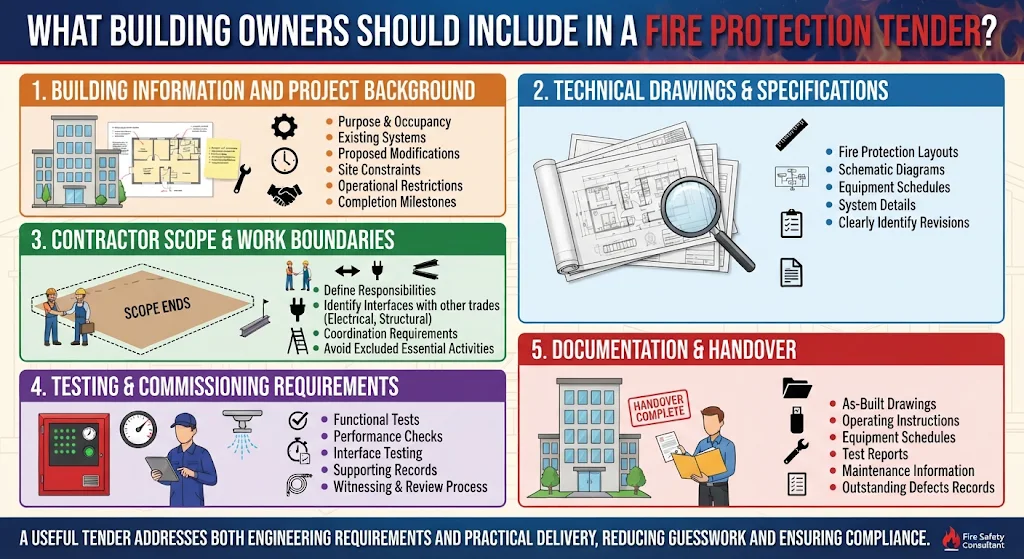
1. Building Information and Project Background
Contractors need to know what they are working with.
Start with the building’s purpose, occupancy, existing systems and proposed modifications.
For an operational facility, explain whether installation works must take place while employees continue their normal activities.
Useful information may include:
- Building location and intended use
- Existing fire protection arrangements
- Available architectural and engineering drawings
- Renovation or expansion details
- Known site constraints
- Operational restrictions
- Required completion milestones
Accurate information reduces guesswork during the tender process.
2. Technical Drawings and Specifications
A contractor cannot reliably price a complex installation without understanding the proposed design.
Relevant drawings may include fire protection layouts, schematic diagrams, equipment schedules and system details.
However, the responsible project professionals must determine which documents are necessary.
The tender should clearly identify drawing revisions and explain the relationship between existing and proposed installations.
If the information contains unresolved design questions, address them before finalising the scope or establish a clear process for managing them.
3. Contractor Scope and Work Boundaries
A good tender explains where each contractor’s responsibility begins and ends.
For example, a fire protection contractor may need electrical connections, structural supports or access arrangements that involve other contractors.
Who will provide those items?
Without clear work boundaries, contractors may exclude essential activities because they assume someone else will handle them.
The tender should identify relevant interfaces, installation responsibilities and coordination requirements.
4. Testing and Commissioning Requirements
Installation completion does not automatically demonstrate that a system performs as intended.
The tender should establish the relevant testing and commissioning arrangements.
Depending on the installation, these may include functional tests, performance checks, interface testing and supporting records.
The project team should also identify who will witness the tests and review the results.
5. Documentation and Handover
Building management needs reliable information after the contractors leave.
Therefore, the tender should identify the records required for handover.
These may include as-built drawings, operating instructions, equipment schedules, test reports, maintenance information and outstanding defect records.
A project without organised documentation can create problems long after construction ends.
ㅤ
ㅤ
Fire Engineering Should Guide the Technical Scope
Fire protection tender preparation becomes more complicated when the building has unusual risks or complex technical requirements.
An industrial facility, for example, may involve combustible materials, chemical processes, high storage arrangements or specialised equipment.
In these circumstances, specifying standard fire protection equipment without assessing the underlying risks may lead to an unsuitable project scope.
Fire engineering helps the responsible professionals evaluate the design considerations before contractors price the work.
Depending on the facility, the engineering team may examine:
- Fire hazards and potential consequences
- Relevant protection objectives
- Water demand and hydraulic requirements
- Fire and explosion risks
- Building layout and escape arrangements
- Integration between fire safety systems
For certain high-risk developments, a Fire Safety Design Philosophy provides a structured approach to evaluating fire hazards and appropriate protection strategies.
FESDES explains this specialist process through its Fire Safety Design Philosophy services.
Not every building requires such a study. Nevertheless, the project team should understand the relevant engineering needs before preparing the tender.
ㅤ
ㅤ
Why the Lowest Fire Contractor Quotation May Not Be the Best
Price matters. Every project has a budget, and owners understandably want to control costs.
However, a cheaper quotation may reflect a different technical interpretation rather than a genuine saving.
Imagine two contractors bidding for an existing warehouse.
The first includes installation work but excludes modifications to the existing control system. The second includes the necessary interface works and associated testing.
If the owner compares only the final figures, the second proposal may appear unnecessarily expensive.
A closer review reveals that the contractors are offering different scopes.
Before selecting a contractor, compare the following:
- Compliance with the stated specifications
- Equipment and material proposals
- Relevant qualifications and experience
- Installation methodology
- Testing and commissioning commitments
- System integration responsibilities
- Exclusions and provisional items
- Documentation and warranty provisions
Ask contractors to clarify significant differences rather than immediately choosing the lowest price.
A technically complete proposal may offer better value than a low quotation that requires substantial additional work later.
ㅤ
ㅤ
Fire Contractor Registration and Competency in Malaysia
Building owners should also consider the qualifications of companies carrying out specialist fire protection work.
Malaysia introduced the Fire Services (Competent Person and Fire Safety Contractor) Regulations 2026, which came into operation on 3 February 2026.
The regulations establish provisions concerning competent persons and fire safety contractors.
They also identify relevant competency categories for specified fire-fighting equipment and fire safety installations.
Consequently, project owners should verify the requirements applicable to their intended works rather than assuming that every contractor can undertake all fire safety activities.
The official Fire Services (Competent Person and Fire Safety Contractor) Regulations 2026 provide the regulatory details.
For current administrative information, building owners should also consult the Fire and Rescue Department of Malaysia.
A tender should request suitable evidence of technical capability and applicable registration. However, the project team must consider the specific activity and relevant transitional provisions when evaluating compliance.
ㅤ
ㅤ
Common Fire Protection Tender Mistakes
Even experienced project teams can overlook important details when preparing a tender under a tight deadline.
Some problems become obvious only after installation begins.
Using Outdated Drawings
A building may have changed significantly since its original construction.
New partitions, machinery or storage arrangements can affect existing fire protection installations.
Contractors who receive outdated drawings may prepare quotations that do not reflect the current site.
Where necessary, arrange a site review and confirm the relevant information before issuing tender documents.
Leaving System Interfaces Undefined
Fire protection installations often interact with electrical, mechanical and building management systems.
For example, a fire alarm system may need to communicate with selected building services according to the approved design.
If the tender does not identify these interfaces, separate contractors may overlook important coordination requirements.
Forgetting Testing and Handover
A contractor may complete an installation but fail to provide all the documentation expected by building management.
This creates uncertainty during maintenance or future modifications.
Define the required records from the beginning and include them in the contractual scope.
Ignoring Existing System Limitations
An older building may have limitations that affect the proposed upgrade.
For instance, its available water supply or existing equipment configuration may require further evaluation.
The technical team should assess these concerns before approving the proposed design.
ㅤ
ㅤ
Fire Protection Tender Planning for Industrial Facilities
Industrial fire protection projects require particular attention because operating conditions can influence both design and installation.
A factory may need to maintain production while contractors work in selected areas.
Meanwhile, a warehouse expansion could change storage arrangements and affect the fire protection strategy.
These situations introduce practical questions.
Can contractors access the required installation areas? Will temporary shutdowns affect business operations? Are existing systems suitable for the proposed modifications?
The tender should address relevant site restrictions and coordination responsibilities alongside the engineering specifications.
For complex facilities, the project team may need specialist studies before finalising the technical scope.
FESDES’s published fire engineering project portfolio includes industrial assessments, Fire Safety Design Philosophy studies and performance-based engineering work.
These examples highlight the importance of understanding project-specific hazards instead of relying solely on generic equipment specifications.
ㅤ
ㅤ
Fire Protection Tender Planning for Commercial Buildings
Commercial projects present a different set of challenges.
Office towers, shopping centres and mixed-use developments may have multiple tenants, shared building systems and contractors working on different areas.
Consider an office renovation where the tenant introduces additional meeting rooms.
The changes could affect fire detection arrangements, sprinkler coverage or existing escape routes.
Although the renovation contractor may focus on the internal fit-out, the project team must consider the relevant fire safety interfaces.
Before inviting quotations, confirm which systems require assessment and identify the parties responsible for any modifications.
A clear tender helps coordinate the required work without allowing important responsibilities to fall between separate contracts.
For designated premises, building owners may also need to consider how modifications relate to their existing Fire Certificate arrangements.
FESDES provides Fire Certificate application and renewal advisory for relevant building compliance matters.
ㅤ
ㅤ
What Happens When a Fire Protection Tender Lacks Technical Clarity?
Unclear tender information can affect both project costs and completion schedules.
Imagine a commercial development nearing handover.
The contractor has installed the specified equipment, but integrated testing reveals an unresolved interface between two systems.
Both specialist contractors insist that their individual installation scopes are complete.
The owner now needs the project team to determine who should investigate the issue and carry out the necessary work.
This hypothetical situation illustrates why technical responsibilities should be established before construction.
A better tender would identify the required interface, allocate responsibility for coordination and define the relevant testing arrangements.
Although no document can eliminate every project risk, clearer specifications can prevent many avoidable disputes.
ㅤ
How FESDES Supports Fire Protection Tender Planning
FESDES provides specialist fire engineering and fire safety consultancy for commercial, industrial and other building projects in Malaysia.
Our technical expertise covers areas such as fire engineering assessment, Fire Safety Design Philosophy, fire protection design considerations and regulatory compliance advisory.
Depending on the agreed appointment, FESDES can help clients examine important technical issues that influence project planning.
These may include:
- Fire safety design requirements
- Relevant fire hazards and engineering considerations
- Fire protection system suitability
- Building code and compliance requirements
- Technical coordination between disciplines
- Design information and documentation needs
- Specialist assessment requirements
The aim is to help project teams understand the technical work involved before making important implementation decisions.
FESDES’s experience across industrial and commercial developments provides a foundation for discussing complex fire safety requirements.
However, the exact consultancy deliverables depend on the project’s scope and the services agreed with the client.
ㅤ
ㅤ
Prepare Your Fire Protection Tender With Greater Confidence
Before inviting contractors to submit quotations, review the technical information available for your building.
Ask whether the drawings reflect the current site, whether the scope identifies important system interfaces and whether contractors will understand the expected testing and handover responsibilities.
If these questions remain unanswered, further engineering consultation may help clarify the project requirements.
FESDES can discuss your building’s fire safety concerns and the technical considerations relevant to your proposed works.
Whether you are planning a new development, upgrading an industrial facility or renovating a commercial property, clearer engineering requirements can support better project decisions.
Contact FESDES to discuss fire protection consultancy and technical project planning in Malaysia.
ㅤ
ㅤ
FAQs About Fire Protection Tender Scope Malaysia
What is a fire protection tender scope?
A fire protection tender scope describes the technical works, specifications, contractor responsibilities and expected deliverables for a fire protection project.
Who prepares fire protection tender specifications?
The appropriate project professionals prepare and review the specifications according to the building’s requirements and their respective technical responsibilities.
Why is fire engineering important before tender preparation?
Fire engineering helps identify relevant safety requirements, assess technical design considerations and clarify the proposed fire protection strategy before contractors prepare quotations.
What should building owners compare in fire contractor quotations?
Owners should compare technical specifications, equipment proposals, contractor competency, scope exclusions, testing requirements and documentation responsibilities.
Should fire protection tenders include testing and commissioning?
Yes. A suitable tender should establish the relevant testing and commissioning requirements and identify the parties responsible for completing and documenting these activities.
Can a fire protection tender affect Fire Certificate preparation?
Fire protection works and their supporting documentation may contribute to fire safety readiness. However, Fire Certificate requirements follow the applicable regulatory process for designated premises.
Is the cheapest fire contractor always the best option?
Not necessarily. A lower quotation may exclude important activities. Building owners should compare technical completeness and project responsibilities alongside price.
Can FESDES assist with fire protection tender planning?
FESDES provides fire engineering and technical consultancy that can support the assessment of relevant fire safety requirements and project coordination needs, subject to the agreed scope of services.